ROLE · Founder | CATEGORY · Digital Scrapbooking | TIMELINE · 3 Weeks

The Problem
In three weeks, I independently researched, designed, built, launched, and tested MMENTO, a private platform for preserving memories and sharing selected moments with close friends. I interviewed 10 people about how they saved and shared meaningful moments.
Sharing required preparation.
Participants chose the best image, edited it, and anticipated how it would be received on Instagram. Habits from Instagram and TikTok made moments feel worth saving only when they also felt worth posting.
Organization created pressure.
Categories, folders, prompts, and streaks helped at first, but eventually made saving a moment feel like a task that had to be completed correctly.
Sharing lacked a comfortable middle ground.
Participants either kept memories private in camera rolls or posted them to broad audiences. They wanted to preserve or share moments only with the people who were part of the moment.
Turning Research Into Product Decisions
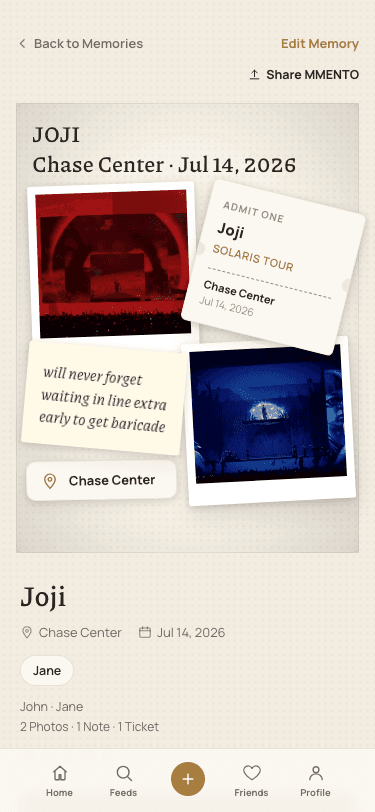
MMENTO combines lightweight capture, a personal archive, and friends only sharing. A memory can include photos, dates, places, people, and context. Saved memories remain available for revisiting, while selected entries can be shared with friends through comments and visible reactions.
In testing sessions, entries named more specific people, places, and reasons a moment mattered. This was an observation, not a experiment. I kept the feed friends only because participants seemed less concerned with presenting a polished version of each memory. However, longer testing will show whether or not that pressure returns among close friends.
Building and Testing the Product
I designed and built MMENTO as a functional web application, currently in a closed beta and anticipating public launch. Being responsible for both the design and the code meant every product decision got tested in a real, working experience rather than a static prototype.
Capturing asks for one decision at a time. Dates, places, people, and context remain optional, while friends can comment and leave visible reactions on shared memories.
The first version required categories and used more prompts. In usability sessions with 10 participants, those choices slowed capture and made simple memories feel as though they needed a complete story.
I removed required categories, shortened the flow, and made context optional. Participants saved more easily when they did not have to classify a memory first. If retrieval becomes difficult as archives grow, I would introduce organization after capture.
Outcome
Participants understood the capture, revisit, and sharing model. One returning participant stopped expecting categories after seeing how few memories she had saved. The small sample served as direction, not concrete evidence. Retention, real world capture volume, and longer-term sharing behavior remain unmeasured.

Reflection
Removing required categories made capture easier, but organization may become valuable as an archive grows. The lesson was not to eliminate features, but to introduce it only when it solves a real retrieval problem.
Other projects


© 2026 Jeffrey Liang